



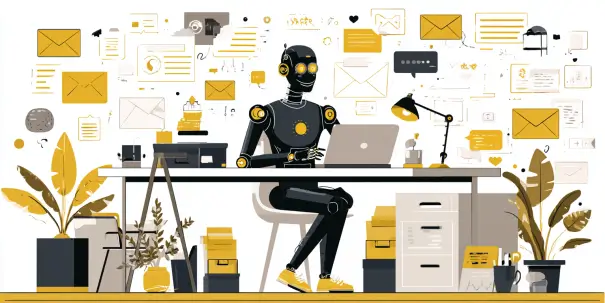
For decades, productivity was measured in simple terms: how much work a person or a team could complete in a given amount of time. In offices, that often meant more emails answered, more reports finished, more calls made, or more tasks checked off a list. Artificial intelligence is now changing that idea in a big way. Instead of only asking, How much did you do? businesses are starting to ask, How well did you decide, create, and deliver?
This shift matters because AI is not just another software tool. It is becoming a work partner that can draft text, summarize documents, organize data, and even suggest next steps. That means productivity is no longer only about speed. It is also about quality, focus, and the ability to use time on the work that truly matters.
From Busy Work to Better Work
One of the biggest changes AI brings is the removal of repetitive tasks. Many workers spend a large part of the day on simple but necessary jobs such as sorting emails, taking notes, preparing meeting summaries, or entering information into systems. AI can handle many of these tasks quickly and often with fewer mistakes.
For businesses, this creates a major opportunity. When AI takes care of routine work, employees can spend more time on planning, customer service, problem solving, and creative thinking. In other words, productivity is shifting away from doing more low-value tasks and toward focusing on higher-value outcomes.
This is especially important for companies that face labor shortages or rising costs. Instead of hiring more people for every new task, leaders can use AI to help existing teams work more effectively. That can improve margins, speed up service, and reduce pressure on staff.
Productivity Is Becoming More Personal
AI is also changing productivity at the individual level. In the past, the same workflow was often expected for everyone. Now, AI tools can adapt to different needs and skill levels. A person who writes slowly can use AI to draft a first version. A manager can use AI to turn a long meeting into a short summary. A salesperson can use AI to prepare for a customer call.
This means productivity is becoming more personal and flexible. The goal is not to force everyone into the same process. Instead, AI helps each person work in a way that fits their strengths. For some, that may mean faster writing. For others, it may mean better data analysis or clearer communication.
That said, companies need to be careful. If AI tools are used poorly, they can create confusion, mistakes, or overdependence. Productivity should not be measured only by output volume. It should also reflect accuracy, trust, and whether the final work is useful.
Managers Are Rewriting Performance Metrics
As AI becomes more common, managers are beginning to rethink how they measure performance. In the past, many teams were judged by visible activity: hours worked, documents produced, or tasks completed. But if AI can complete many of those tasks in minutes, then activity alone is no longer a good measure of value.
Instead, more leaders are looking at results. Did the customer issue get solved faster? Did the team make a better decision? Did the project move forward with fewer delays? These are the kinds of questions that matter in an AI-supported workplace.
This change could lead to healthier work environments. Employees may feel less pressure to look busy all the time and more freedom to focus on meaningful results. However, it also raises new questions about fairness. If one worker uses AI more skillfully than another, does that mean they are more productive, or just better equipped? Businesses will need clear rules and training so that AI helps reduce gaps rather than widen them.
The New Value of Human Skills
Some people worry that AI will make human workers less important. In reality, it is making certain human skills more valuable. As machines take over routine tasks, people who can think critically, build relationships, and make sound judgments become even more important.
For example, AI may help write a draft, but a person still needs to decide whether the message is right for the audience. AI may organize a data set, but a human still needs to understand what the numbers mean for the business. AI may suggest a plan, but leaders still need to weigh risks and make final decisions.
This is why productivity in the AI era is not just about working faster. It is about using human judgment where it matters most. Workers who learn how to guide AI, check its output, and combine its suggestions with their own experience will likely have a strong advantage.
What This Means for Businesses
For companies, the biggest strategic impact of AI may be the chance to do more with the same resources. That can mean better customer support, faster product development, improved internal operations, and stronger competitiveness. Businesses that use AI well may be able to move faster than rivals that rely on older methods.
At the same time, adoption must be thoughtful. AI tools should be introduced with training, privacy controls, and clear expectations. If employees do not understand how to use the tools, the result may be frustration instead of improvement. If the data used by AI is poor, the output will also be poor. So productivity gains depend not only on the software, but also on the quality of the process around it.
There is also a financial side. AI can lower operating costs, but it may also require new spending on software, cloud services, security, and employee training. Leaders must look beyond the initial excitement and evaluate whether the tools truly improve business results.
A Broader Redefinition of Work
In the long run, AI is pushing companies to rethink what work is for. Is the goal to produce the most output possible, or to create the best value with the least wasted effort? That is a deep shift. It suggests that productivity should be measured not only by quantity, but by usefulness, quality, and human well-being.
For older workers and people who are not deeply familiar with technology, this can sound intimidating. But the basic idea is simple: AI is meant to remove some of the hardest and most repetitive parts of work so people can spend more time on tasks that require care, experience, and common sense. When used well, AI does not replace productivity. It helps redefine it.
The companies that understand this change early will likely have an edge. They will not just work faster. They will work smarter, with clearer goals and better use of human talent. In that sense, AI is not only changing how we work. It is changing how we think about what productive work really means.